Cross a national border by boat and a small piece of fabric suddenly carries a lot of weight. Flying the right flag, in the right place, in good condition tells a host country you know the customs of the sea and respect its waters. Flying the wrong thing — or a faded, undersized flag — can read as carelessness or worse. The rules around courtesy flags and the yellow Q flag are not complicated, but they trip up plenty of first-time cruisers, and they directly shape what you should order before you leave.
What a courtesy flag is and why it matters
A courtesy flag is the national maritime flag of the country you are visiting, flown from your own boat as a gesture of respect while you are in that nation’s waters. It does not replace your own ensign, which stays at the stern to show your vessel’s nationality; the courtesy flag sits alongside it to acknowledge whose waters you are in. The practice is a long-standing convention rather than a printed law in most places, but it is taken seriously. In some ports a worn or clearly undersized courtesy flag is considered more offensive than flying none at all, because it looks like an afterthought. Treating the courtesy flag as a real part of your kit — correct country, correct proportions, clean condition — is the whole point.
The arrival sequence: Q flag first, courtesy flag after you clear in
There is an order of operations, and it starts before you have spoken to a single official. As you enter a country’s territorial waters and before you have cleared customs and immigration, you fly the Q flag — a solid yellow flag from the International Code of Signals, letter Q — to signal that your vessel is healthy and requesting free pratique, meaning you have not yet checked in. The Q flag goes up on arrival and stays up until officials have cleared your boat. Only once you have completed customs, immigration, and any health formalities do you lower the Q flag and hoist the courtesy flag of the host country in its place. In practice, many cruisers raise the courtesy flag above the Q flag in anticipation of clearance, and in many countries that is quietly accepted, but the clean, correct version is Q first, then courtesy flag once you are legally in. Details vary between authorities and even between the guides that describe them, so when a specific country publishes its own expectation, follow that.
Where each flag flies
Position matters as much as the flags themselves. On a boat with a mast and spreaders, the courtesy flag — and the Q flag before it — flies from the starboard spreader, the right-hand horizontal spar as you face forward. On a vessel with more than one mast, use the forward mast’s starboard spreader. Nothing should fly above the courtesy flag on that halyard; it holds the senior position on the starboard side. Your own national ensign remains at the stern, and a yacht club burgee or private signal, if you fly one, moves to the port spreader so it never sits above the host nation’s flag. A boat without a suitable mast flies the courtesy flag at the bow. One more caution: resist the urge to run up flags for every country on your itinerary at once, which can be misread and cause offense rather than showing enthusiasm.
Sizing your courtesy flag
The traditional sizing rule is simple arithmetic: allow about a half inch of fly — the horizontal length — for every foot of your boat’s overall length. A 30-foot boat lands around a 15-inch flag by that rule, a 40-footer around 20 inches, and so on, as the chart below shows. In everyday cruising practice, many sailors settle on a common stock size around 18 inches (a “half yard”) for boats up to roughly 60 feet, because it reads clearly from deck level without becoming unwieldy aloft. Use the rule as your starting point, then sanity-check it against what will actually be legible on your rig.
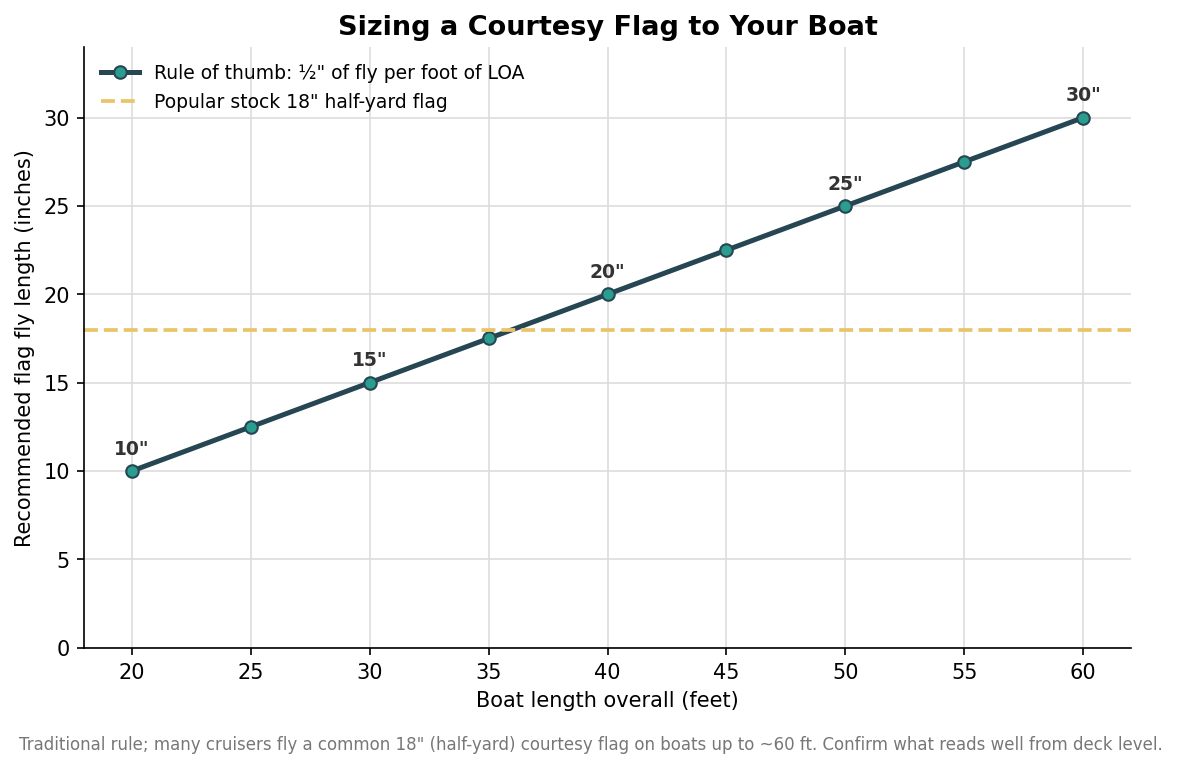
Err toward the correct size rather than the smallest one you can get away with. An undersized courtesy flag is one of the specific things that reads as disrespect in a host port, so if you are between sizes, the larger is usually the safer choice.
Getting the proportions and quality right
Here is the detail that catches people ordering custom or printed flags: national flags do not share one universal shape. The United States flag is proportioned 10:19, giving a long, narrow rectangle at about 1.90 to 1; the United Kingdom, Canada, and Australia use 1:2, an even longer 2.00 to 1; France, Italy, and Spain use 2:3, a squarer 1.50 to 1; and Germany uses 3:5, near 1.67 to 1. The chart below compares them.
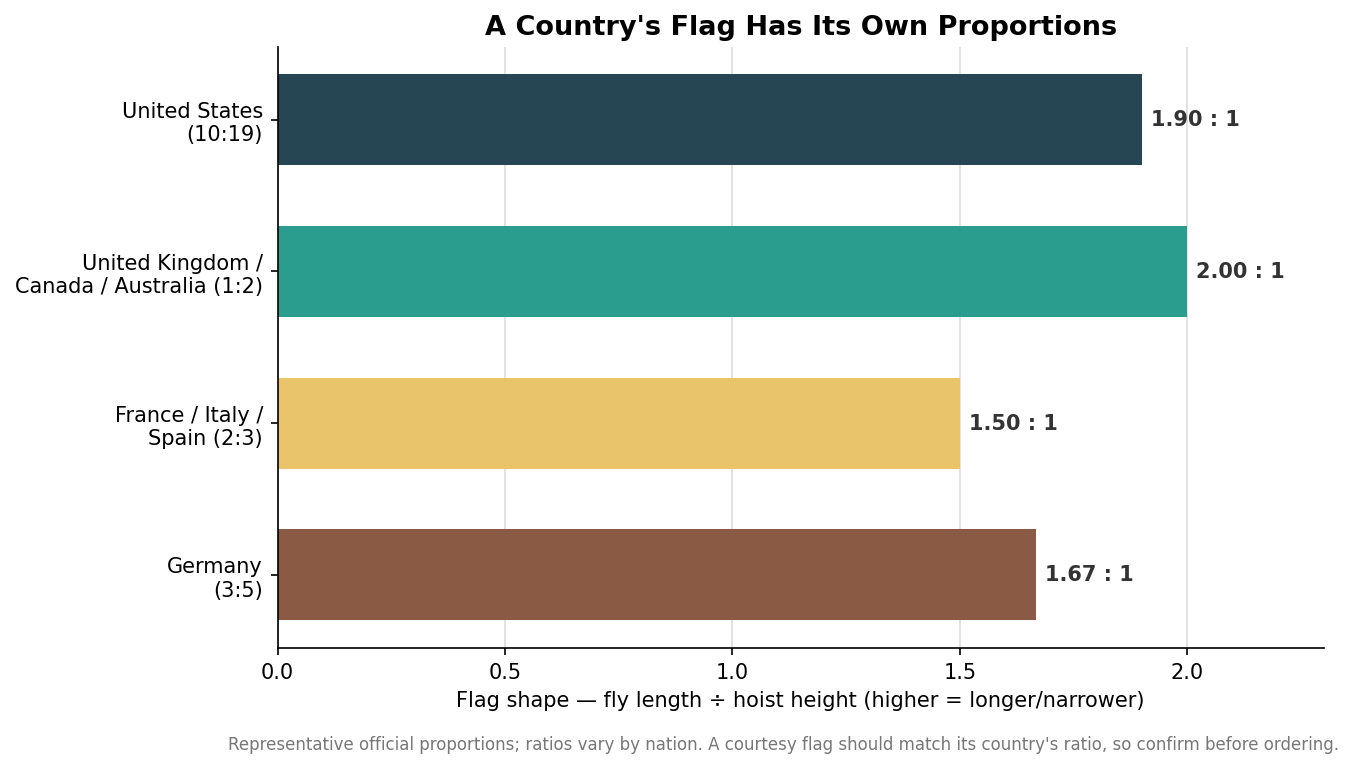
Printing a country’s flag at the wrong aspect ratio produces something that is subtly but unmistakably not that flag, which defeats the courtesy entirely. If you are having courtesy flags made, match each one to its country’s official proportions rather than forcing every flag onto a single blank size. Just as important is the material and finish for life at sea: marine courtesy flags take constant UV, salt, and wind, so a tight-weave synthetic with reinforced stitching at the fly holds its shape and color far longer than a thin novelty flag. All the figures here — the half-inch-per-foot rule, the national proportions, the arrival sequence — are the widely used conventions, but specifics genuinely vary by country and authority, so confirm the host nation’s own guidance and your supplier’s exact sizes before you order and before you cross the line.