Getting a flag onto a boat is really two problems, and buyers usually solve them in the wrong order. Most people pick a flag, then discover it is the wrong size for the boat and has nowhere solid to mount. Size the flag first, choose a mount that suits your hull and how often you want to remove it, and then buy hardware that will not rust away by midsummer. Do it in that order and the flag looks proportioned, flies clear, and survives the season.
Size the flag before you pick a mount
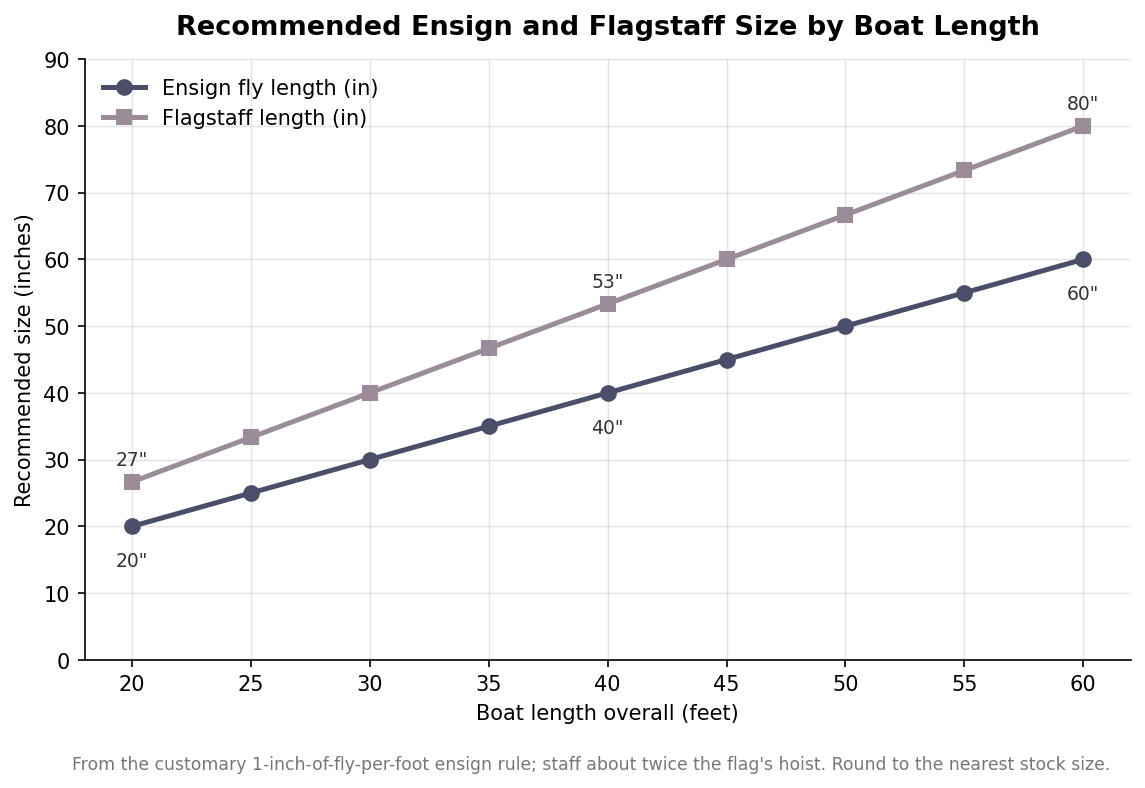
The customary rule for a national ensign is one inch of fly length for every foot of the boat’s overall length, so a 33-foot boat carries roughly a 24-by-36-inch ensign. The flagstaff should be about twice the flag’s hoist, meaning its vertical edge, which puts that same 33-footer on a staff near 48 inches. Courtesy flags, flown when you visit foreign waters, run smaller; a 12-by-18-inch flag suits most recreational boats up to about 40 feet. Burgees and private signals follow their own lighter convention, customarily around a half inch of fly per foot of the highest point they fly from, so they stay modest even on a tall rig. These are guidelines rather than laws, and a shorter staff is fine when space is tight; the real priorities are that the flag is visible, reads as proportional to the boat, and hangs clear of obstructions. Round to the nearest stock size rather than ordering an odd dimension.
Match the mount to your boat
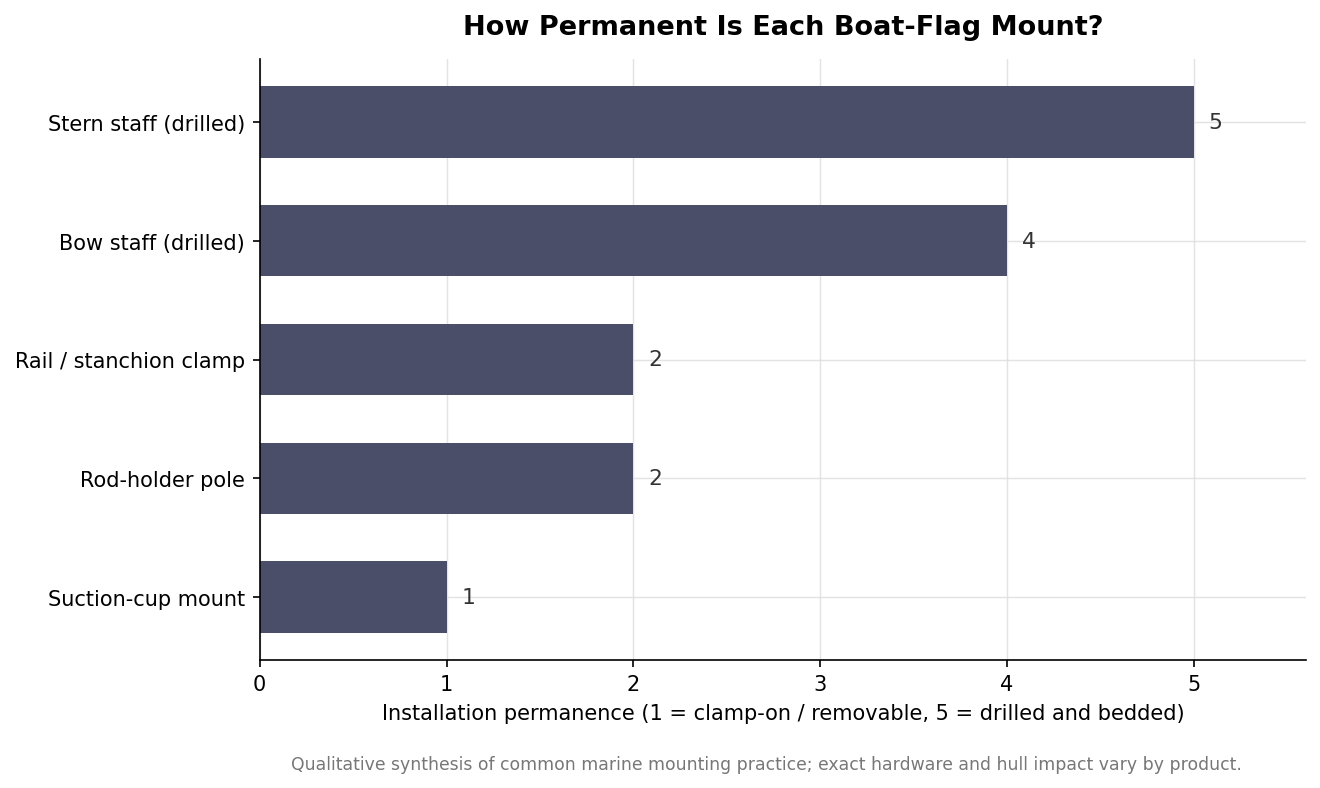
The right mount depends on your hull and how permanent you want the installation to be. Rod-holder flagpoles drop a tapered base into an existing rod holder, typically a 1.5- to 2-inch tube, which makes them the natural choice on fishing boats; a locking collar keeps the pole from lifting, and they suit smaller flags because a large one overloads the holder in a gust. Stern staff mounts are the standard on powerboats, cruisers, and yachts, available as removable socket styles, fixed 45-degree angles, or adjustable brackets, and they give the ensign its proper place at the stern. Rail and stanchion brackets clamp around a vertical post, usually 7/8 to 1 inch in diameter, which makes them ideal for sailboats with lifelines and appealing to anyone who wants no holes in the boat. Suction-cup mounts exist for rental boats, personal watercraft, and temporary displays; heavy-duty cups three to four inches across hold on smooth, non-porous surfaces but should not be trusted in rough water. Bow staff mounts, positioned on the centerline where possible, are where a burgee or private signal typically flies.
Hardware that survives salt water
Marine flag hardware fails in predictable ways, almost always because someone economized on metal. For saltwater use, specify 316-grade stainless steel for the mount and every fastener; 304 stainless is acceptable in fresh water but corrodes faster in salt. Avoid chrome-plated brass and mild steel outright, since both streak and rust within a season. Any mount that fastens to the hull should be bedded in a marine sealant and backed with a plate on the inside face to spread the load, and both the holes and the base plate want sealant so water never reaches the core of the deck. Give a structural sealant such as 3M 5200 the full 24 to 48 hours it needs to cure before you put the staff under wind load. None of this is exotic, but skipping the backing plate or the cure time is how a stern socket works loose and takes a chunk of gelcoat with it.
Placement and clearance
Height and position decide whether the flag reads correctly and whether it survives. A flagstaff should extend above the boat’s highest fixed point, not counting antennas and outriggers, so the flag is visible without looking undersized. Keep the ensign at the stern, fly a courtesy flag from the starboard spreader on a sailboat, and reserve the bow staff and masthead for burgees and signals as etiquette dictates. Just as important is mechanical clearance: the flag and staff should swing without fouling antennas, biminis, outboards, or exhaust, because a flag that whips against standing rigging or a hot exhaust will shred or scorch in days. On a boat that trailers, plan the mount so the staff comes off easily, since highway wind loads are far harsher than anything the flag meets on the water.
Keep it flying
A flag is a consumable, but a little routine doubles its life. Remove the flag before trailering or long runs at speed, because sustained high wind is what frays the fly edge fastest. Rinse both hardware and flag with fresh water after saltwater exposure to stop salt from grinding at the fabric and the fittings alike. When a flag needs cleaning, hand wash it in cold water with a mild detergent and let it air dry completely before it goes back up or into storage, since heat and hard drying break down the coatings that keep printed colors bright. Inspect the mount and the flag monthly, paying attention to the fly end where fraying starts and to any fastener showing rust, and replace a flag once the trailing edge begins to unravel rather than waiting for it to tatter. A frayed flag is not just untidy; it signals a boat that is not being watched closely, which is the opposite of what a well-chosen flag is meant to say.
Flags are small, but the way they are sized and mounted is disproportionately visible. Match the flag to the boat’s length, pick a mount that fits your hull and your tolerance for drilling, use 316 stainless wherever salt is involved, and give the fly edge a look each month. That is the whole job, and it is the difference between a flag that finishes the season crisp and one that is in tatters by August.